

Carry forward the spirit of craftsmen
Solid security industry
Introduction to Accessories of Positive Pressure Air Breathing Apparatus
2021-01-29
Positive pressure air respiratorIt is a respirator frequently used by firefighters. The positive pressure air respirator uses a mask to seal the wearer's face, completely isolating the wearer's breathing, eyes, and face from external air or low-oxygen environments. It has its own compressed air source to provide clean air for the wearer to breathe. The exhaled gas is directly discharged into the atmosphere, and during any breathing cycle, the pressure in the mask is greater than the ambient pressure.
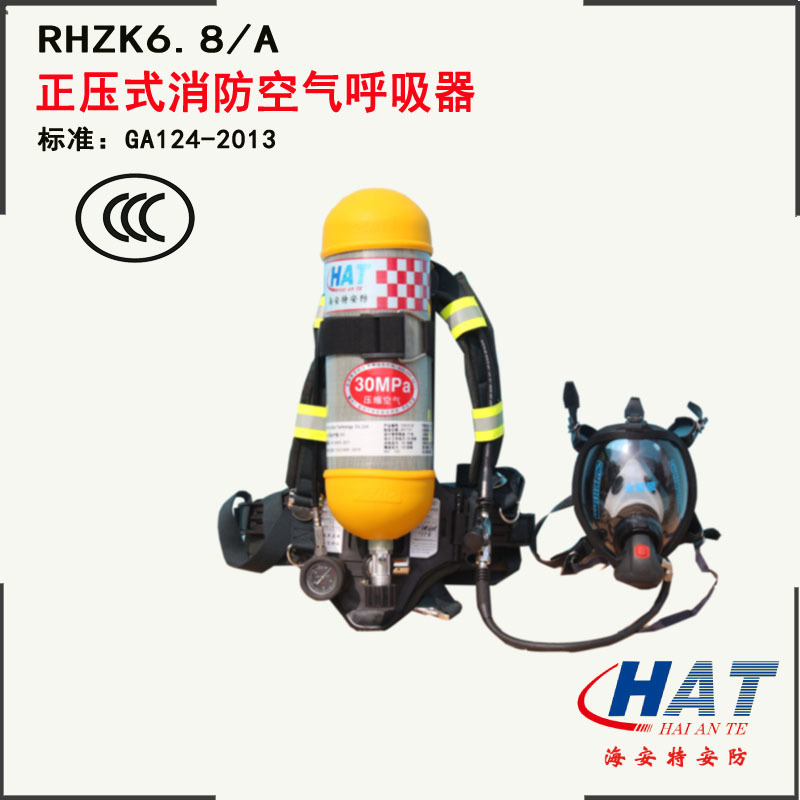
Positive pressure air respiratorThe structure should be simple and compact, allowing for independent wearing and use without assistance, and it should enable breathing in narrow passages. The wearer should be able to continue breathing from the respirator while still wearing the full mask after removing the respirator. The respirator should have a device to prevent impurities in the compressed air, and the outside of the cylinder should have a protective cover. After opening the cylinder valve, the pressure gauge should display the cylinder pressure, and its installation position should be convenient for the wearer to observe the pressure value.
The headband or hood of the positive pressure air respirator should be freely adjustable according to the needs of the wearer's head, and the sealing frame should fit closely to the wearer's face without significant pressure pain. When wearing glasses, the connection should be reliable and without noticeable shaking. The visual window should not cause visual distortion, with a total field of view retention rate of no less than 70%, a binocular field of view retention rate of no less than 55%, and a lower field of view of no less than 35%. The lens's light transmittance should be no less than 85%, and the carbon dioxide content in the inhaled gas should not exceed 1%.
Positive pressure air respiratorAlarms can be divided into two types: pneumatic alarms and electronic alarms. Currently, pneumatic alarms have gradually exited the market, and electronic alarms are more commonly used in practice. First, let's understand the pneumatic alarm. When the cylinder pressure drops to 5.5±0.5MPa, the alarm should emit a continuous sound alarm or an intermittent sound alarm. The continuous sound alarm should last for at least 15 seconds, and the intermittent sound alarm should not be less than 60 seconds, with a sound frequency range between 2000Hz-4000Hz. After that, the alarm should continue until the cylinder pressure drops to 1MPa. It is important to note that from the moment the alarm is activated until the cylinder pressure drops to 1MPa, the average gas consumption of the alarm should not exceed 5L/min.
The functional requirements of the electronic alarm are actually the same as those of the pneumatic alarm. For more details, you can call for consultation. Compared to pneumatic alarms, electronic alarms can connect to display devices in the mask via Bluetooth or other means, allowing for multiple alarms.
The above is an introduction toPositive pressure air respiratorrelated accessories. If you want to learn more about positive pressure air respirators, please continue to follow Jinan Hai'an Te'an Security Equipment Co., Ltd.
Key words:
Contact Us
Service Phone:
Contact E-mail:
Contact Address:
100 meters south of Chengnan Chenzhuang Junction, National Highway 220, Changqing District, Jinan City, Shandong Province
More information
The company's core manufacturing and production of head protection, body protection, respiratory protection, fire fighting and rescue and other series of professional products, to give customers special environment from head to toe safety protection.
Column Menu
Contact Us
100 meters south of Chengnan Chenzhuang Junction, National Highway 220, Changqing District, Jinan City, Shandong Province
Service Phone:400-666-9811/+86-531-87216666
E-mail:3087088615@qq.com
Sales Department Telephone:+86-13964160188
Business hours: 8:00 a.m. -22:00 p.m. (normal answer on Saturday and Sunday)

Public QR Code

TikTok QR Code